|
Commentary for "Kufuor, A New Face"
documentary
E.
Ablorh-Odjidja
February 01, 2012
A
question is asked: Who will be the most consequential state-person in
Ghana for this new century? The answer, some will say, of course,
lies in the future.
But
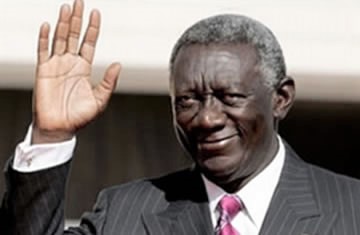
we offer now that it is J. A. Kfuor, President of Ghana, from 2001 to
2008.
President J. A. Kufuor was the first true civilian president to have
survived two mandated terms in office since 1966: after over 50 years of
political turbulence in our country.
Before his presidency, Kufuor wasn’t idle on the Ghanaian political
scene either. He has been active from the first regime of Nkrumah to
now.
Therefore, no commentary can be made about politics in Ghana, without
the need to incorporate into the narrative some aspects of his life’s
work and experiences.
And
should that commentary be done, readers would find it meaningful and
informative.
It
was sometime in May 2008, when I got the chance to meet with President
Kufuor, through an introduction by a mutual friend.
I
informed the president of my wish to produce for history a documentary
on his presidency and administration.
Of
particular interest to me as one of the subjects to be discussed (and a
crucial one at that) were the changes and the transformations in
governance that I had come to experience on my many visits to Ghana
during his term in office.
I,
like many at the time, felt that, with his regime, we had arrived at an
intersectional point in our history; from a recent dark past to a
beginning of what looked like a bright spot, after many political
upheavals and changes in regimes.
How
we got to this point in 2007, I surmised, was because of the election of
President Kufuor to office.
In my
conversation with Mr. Kufuor, I noticed he had aimed to preserve the
good in our political affairs, regardless of changes in regimes and his
partisan views, for the benefit of posterity.
During the conversation, I felt the need to bring up a routine that was
bedeviling the national politics; the practice of "policy reversals" by
different regimes.
This
practice has routinely happened since the overthrow of Nkrumah.
So much good has happened under Kufuor's regime that I feared
might not stand should a change to an adversary regime happen.
Policy reversals have produced a quagmire in our governance.
It
was President Kufuor who readily named the phenomenon as “policy
reversals” before the question left my mouth.
My query was whether these changes troubled him, since they may
affect his legacy.
President Kufuor, a veteran politician, had witnessed these “policy
reversals.”
He
noted that we have had more policy reversals in our short history than
most stable and advanced nations can count in centuries.
In
the grip of "policy reversals", many good ideas and intentions of
preceding regimes have been abruptly shelved, damaged, or buried for no
other reason than political zeal.
Thus,
“policy reversals” have become an essential ingredient of our national
political character. Consequently, our national progress has been
hampered. And the many coups that followed since 1966 have made the
“reversals” worse.
The
birth of the Fourth Republic of Ghana happened in 1992 when J. J.
Rawlings, the former coup maker of 1981 and military ruler became a
civilian president. His
civilian presidency occurred after he transformed his pseudo-political
revolutionary PNDC to a regular political party in 1992.
In
2001, Kufuor became the second president of the fourth republic. And a
new regime was born under his NPP administration.
Rawlings’ continuous rule of 19 years, under the PNDC and the NDC,
created a very fragile moment for the transition to Kufuor.
Brutalities under Rawlings had happened. Nerves of the incoming NPP
politicians were raw and exposed. Retribution, therefore, was on the
minds of many, as a countless number of citizens in Ghana had expected.
Fortunately, the settling of scores did not happen. The most grievous
settlings that would have been justified became severely muted because
of the Kufuor National Reconciliation Commission initiative.
The
National Reconstruction Commission was charged to investigate “abuses of
human rights inflicted on persons by public institutions and holders of
public office during periods of unconstitutional government."
Had
it not been for this initiative, the consequences of the brutalities
under Rawlings could have been worse for Ghana. But with this move,
many saw Kufuor’s election as propitious and providential.
Kufuor was known as the “Gentle Giant,” towering about 6’ 3’’ tall and
he was at the helm of affairs in Ghana.
By nature, he also happened to be a very calm person. This calm
demeanor and sensible approach to governance was to become the key
feature of Kufuor’s administration.
While
civil catastrophes were occurring elsewhere in Africa during this same
period, Kufuor’s influence became a colossal safety valve for Ghana.
The peace he brought translated to stability and jobs. When he
left office, the world saw a progressive country recovering its steps on
the march to self-empowerment.
His administration, many agreed, was transformational.
It provided eight years period of growth for the country, both in
the socio-economic and the psychic sense.
On a
visit to Ghana in July 2009, six months after Kufuor’s departure from
office, the then-new US President, Barrack Obama had this to say:
“(By)
traveling to Ghana, we hope to highlight the effective governance that
they have in place. … we have seen progress in democracy and
transparency and rule of law, in the protection of property rights, in
anti-corruption efforts…And I think that there is a direct correlation
between governance and prosperity.”
As
the intended producer of this documentary on Kufuor, "A New Face for
Africa," Obama’s statement could not have been more auspicious when I
heard it for the first time.
The
problem was, I had still not been able to get President Kufuor in front
of a camera.
On
August 27, 2009, I had my chance to do the shoot, on a makeshift stage
at his house in Accra. I had Matilda Asante, a radio, and television
personality as the interviewer.
What
resulted was a biographical sketch as well as a narration on the
policies and the developmental intents of the Kufuor’s presidency for
Ghana.
I
chose the title “A New Face for Africa” because Kufuor, by peacefully
departing from office during a testy time following the 2008 elections,
demonstrated a trait of statesmanship that was rare in Africa.
Two
years out of office later, Kufuor’s example was to be made
clearer. There occurred a stalemate in transition in the Ivory Coast
when Laurent Gbagbo, the sitting president, refused to step down after
his term in office. The result was the civil war that broke in that
country in 2011.
For
more exposure to President Kufuor, I interviewed others in his
administration as well as an outsider.
Both sides had the chance to state their views about him. In the
end, I found no need on my part, as the producer, to shape the views I
had collected so far, with a verbal overlay of my own other than the
images shown in the documentary.
There
was, in part, an inner dynamics in the coverage of the various scenes
and situations captured that flowed into each other.
The result was in a silent objective narration of its own that I
thought was enough.
There
was the opening scene that featured the transition from Kufuor to the
new administration led by President Atta Mills.
Following that was the episode on the opening of the new Presidential
Palace, the “Golden Jubilee”. A majestic facility built with a soft
loan from India, that essentially was a gift, the fruit of skillful
diplomacy that belonged now exclusively to the “Gentle Giant,” Kufuor.
Even
the gift produced a political crisis. The opposition could not be
pacified. And the Golden Jubilee name had to be sullied. And the first
salvo at “policy reversal” was off, when the opposition demanded a name
change.
.
Predictably, early in 2009, the new NDC administration decided to change
the name "Golden Jubilee" to "Flag Staff House."
The act was followed by other
comedy of errors of that same nature.
The
reason for the change of the Golden Palace was to honor Dr. Nkrumah, the
first president of Ghana, said the NDC.
So, the old name of Flag Staff House was brought back and the entire
presidential office was moved out of the new palace to the old Osu
Castle.
The
irony was Nkrumah left the Osu Castle because he said that the castle
was a slave fort. Why the NDC would want to return to the castle to
honor Nkrumah's ghost should not be a misery.
Within a year of the new NDC administration, the Golden Jubilee name was
gone. The Flag Staff House
name was back. And the
Castle has reverted as the seat of administration for the NDC
government.
Thus,
a good well-thought name, that celebrated Nkrumah and Ghana's jubilee of
independence commemoration, was also to be reversed on a political whim
constructed out of spite and not reason.
And the Flag Staff House name, one that recalled and “glorified
Ghana's Gold Coast past,” when
the commandant of the British colonial army used the place as his
residence, was restored!
Only
in Ghana could a comedy of errors be accomplished with one stroke of
electoral victory. These
episodes of change went to show, in sum, how “policy reversals” were
accomplished by political parties or regimes in Ghana.
True
to the "policy reversal" form, the NDC ignored the honor that Kufuor had
paid Nkrumah when "Jubilee Palace" was built.
Inside the now renewed
Flag Staff House was the refurbished old residence of Nkrumah, which Kufuor had already turned into a museum to properly honor the first
president of Ghana.
But
the NDC had no use for this honor for Nkrumah, the man they claimed they
shared ideological affinity with because it came from Kufuor. Policy
reversal was the goal and they intended to make it stick.
"Policy reversal" so far has gone on to wipe out prior initiatives by
preceding administrations. Some new leaders see the "reversals" as a
form honored. By this
Ghanaian tradition, they saw a chance to cut down their predecessors’
reputation; forgetting that the same could happen to them in return.
Myopia and hunger for power have guaranteed that the trend continues.
But
Kufuor’s time in office marked a spectacular difference. It was an era
of revival of some old positive ideas and policies, reaching as far back
as the days of Nkrumah.
The speed with which he embraced and restarted the Bui Dam project
was an example, thereby showing that he was not an ideologue.
His
main achievements, the building, and commissioning of the Bui Dam,
schools, the Bush Highway and others, expansions in public utilities ike water and
electricity, and the tackling of other national infrastructure needs,
showed that Kufuor was a committed statesman who rose above the ordinary
politician.
Kufuor's accomplishment on the international scene was also staggering.
Kufuor policies helped obtain from institutions like the UN, World Bank,
and IMF debt forgiveness, now known as the Heavily Indebted Poor
Countries (HIPC) debt forgiveness Initiative. These policies also
led to wiping away Ghana's staggering external debts of the era.
Same policies led to Ghana winning a grant of $500 million plus
from the US Millennium Challenge Account (MCA),
under President George W. Bush,
for a compact country-led development projects.
By
the time President Obama visited Ghana in 2009, Kufuor had
already left his mark on the country.
And the country was on course for socio-economic stability.
Obama’s statement was made six months after Kufuor had left office.
“Countries that are governed well, that are stable, where the leadership
recognizes that they are accountable to the people and that institutions
are stronger than any one person has a track record of producing results
for the people. And we want to highlight that,” President
Obama said.
President Obama’s statement was not an affirmation of the new NDC
administration's policies.
The
Kente weavers of the village of Adamhomase, near Bonwire, had already
experienced what President Obama saw. They affirmed in one voice that
Kufuor, the “gentle Giant” had “lifted the image of the country” by the
way he conducted himself in office.
And
the film, Kufuor A New Face for Africa - agrees with the assessment of
these simple folks of Adamhomase.
E.
Ablorh-Odjidja, Publisher www.ghanadot.com, February 02, 2012.
Permission to publish: Please feel free to publish or reproduce, with
credits, unedited. If posted on a website, email a copy of the web page
to publisher@ghanadot.com. Or don't publish at all.
|