|
|
The fate of Africa revisited
A review of the Book by
Martin Meredith
“The Fate of Africa”
E. Ablorh-Odjidja
January 11, 2009
Cont'd / Page Two
Page One
As said, writers
like Martin Meredith would not allow contemporary
truth to stand in the way of historical lies.
For example, when there is a
heroic story to tell about Nkrumah, but Meredith
avoids telling it, even to the detriment of his own
scholarship.
Imagine Meredith devoting
about 24 pages of his book to tell consecutively the
story of the Congo, the UN, Lumumba and the era of
the Congo crisis and not a word was said about
Nkrumah's involvement with the Congo!
Nkrumah’s famous Broadcast on
the Congo in 1960, which gave a clairvoyant view of
what was to happen, is never highlighted.
The heroic example of Ghana
being the first country to send soldiers to aid this
troubled country is ignored.
Yet Meredith pretends to focus on leaders “whose character and
careers had a decisive impact” on the fate of their
countries and therefore the continent of Africa.
But forget the Congo,
Meredith is also more than willing to neglect the
impact of Nkrumah on Diasporan Africans.
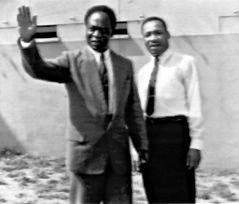
In 1957, at Ghana's
independence, among the invited unofficial guests
for the occasion was Dr. Martin Luther King, Jr.
Who knew at that time what Dr. King was
destined to be and why Nkrumah had invited him to
the celebration in Ghana?
The answer could be a very informative,
unless Meredith’s intention is to suppress the
positive message.
But that invitation becomes
very significant if you were to examine its impact
on the Civil Rights movement in America.
It was in Ghana in 1957, that
Dr. King got the chance to meet with then Vice
President Nixon, which meeting led to an invitation
by Nixon for Dr. King to visit President Eisenhower
at the White House.
And that meeting led to the crafting of the
Civil Rights Act of 1957.
So, out of Ghana came a
moment of understanding that brought Civil
Rights issues into prominence, that some called the
most significant legislation on race relations since
the Reconstruction era in America.
And also out of the Civil Right Act of
1957, essentially a voting right bill, came the
Civil Right Act of 1964, that banned
segregation in school and public places in America.
A lot of good has been done since in America.
And just
a word of reference
linking the invitation to this great racial issue in America
and one event in Ghana, under the auspices of
Nkrumah could have aligned the late
President’s reputation to something good.
But no, Meredith sees to it that Nkrumah
is denied the honor.
There is the need to make
this claim on Nkrumah's behalf, since, obviously
Meredith wouldn't.
This is not to say that
Nkrumah started the Civil Rights movement in
America.
Call the meeting between Nixon and Dr. King a chance
encounter or providential.
But there is no denying that Dr. King was in
Ghana because of the special invitation by Nkrumah.
Equally reckless is
Meredith’s example of assigning blame for the
construction of “prestigious” buildings in state
capitals, in the post-colonial period, as one of the
things that went wrong in Africa, to Nkrumah.
The most glaring example, he
says, is the lavish spending on projects which
occurred when African governments competed for the
privilege of holding the first conference of the
organization of African Unity.
Meredith says, “Nkrumah set
the precedent in 1965 by building a palace
containing sixty luxury suites and a banquet hall
capable of seating 2000 guests” to serve the OAU.
Derisively, he states
"twenty-eight out of thirty-six of the members of
the OAU attended the meeting" during the opening,
"but only thirteen were represented by heads of
state.
No one supported his call for a union of Africa."
First, let's correct the
impression of the building he calls “palace.”
It was a sprawling structure
called “The State House;” housing 60 suites or
luxurious apartment meant for heads of African
states and a conference hall fit for the
deliberation of matters concerning Africa and the
world.
Nkrumah's dream for a
continental government was an ongoing process; that
by 2005 when Meredith published his book, some 50
African states have become members of the AU (OAU).
Nkrumah’s idea and dream were on their way, but he
gets no praise from Meredith.
At least, if the idea for a
continental government is not worthy in Meredith
eyes, he shouldn’t pretend that the number of
memberships supporting the idea has not grown.
For blame for the low
participation at the conference in 1965 that
Meredith cites, he ought to have turned more
attention on the political dwarfs surrounding
Nkrumah at that time, of which his hero of the era,
Houphouet-Boigny, was one.
The building Meredith derided
as the "crowning folly of Nkrumah's regime," is now
the seat of Ghana National Parliament.
By the way, the magnificent
cathedrals of Europe, built centuries ago with
scarce resources then, are almost empty on Sundays
now and Buckingham Palace still houses one family.
In conclusion Meredith
writes, “After decades of mismanagement and
corruption, African states have become hollowed out.
They are no longer instruments capable of serving
the public good.”
True, but the statement
sounds very reminiscent of the condition in some
African states when the colonials left.
And in the case of Ghana, the
statement became truer, especially after 1966, and
gradually worse until very recent.
Meredith's book is a shoddy
analysis of what went wrong in Ghana and on what
brought Nkrumah down.
When he states "Nkrumah's downfall… came ...
because of his fatal decision to interfere with the
military,” he is clearly providing a diversion from
what really went wrong.
The failure to notice the
reason for Nkrumah’s ouster is not a product of a lack
of intellectual ability or curiosity.
It is a complete denial of the obvious.
Long before Meredith wrote his book in 2005,
the world knew who corrupted the armed forces of
Ghana in order to overthrow Nkrumah and why.
As background to
understanding Nkrumah and Ghana, I will recommend
the book “Reap the Whirlwind,” by Geoffrey Bing, a
former member of British Parliament, who served
as Attorney General and a legal advisor to Nkrumah.
To finish off the quest, I
will humbly invite Meredith and company to pay close
attention to contemporary Africa.
They will see the rugged
existence of some of Nkrumah's positive ideas.
Driving it
all is a robust dynamism that can only be
intentionally missed.
Nkrumah, to say the obvious, is not a god.
We ask only
to see him as Meredith probably sees a Churchill,
Roosevelt, Max, Mao or Lenin.
Not much to ask for, I should
say. Being an African should not stand in the way.
But I doubt.
E. Ablorh-Odjidja, Publisher
www.ghanadot.com, Washington, DC, January 11, 2009
Permission to publish:
Please feel free to publish or reproduce,
with credits, unedited.
If posted at a website, email a copy of the
web page to publisher@ghanadot.com
|